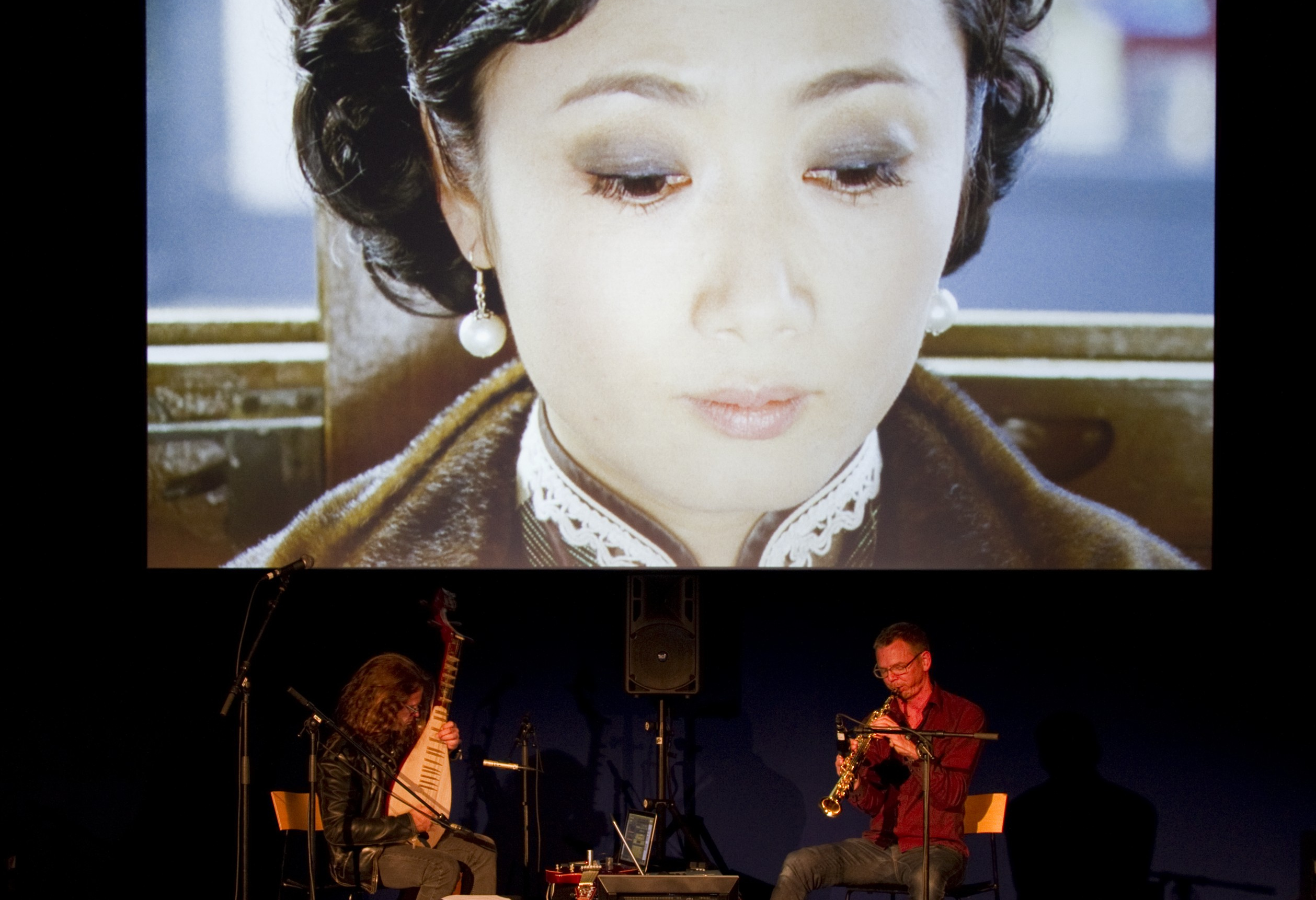
Henrik Frisk and Stefan Östersjö: Music for Better Life
With its urgent experimental narrative and exquisite imagery, Better Life is a film with immediate appeal. Thematically, it has many links to our own artistic practice, but our first contact with the film raised several questions concerning the form for our collaboration with Isaac Julien. Firstly: isn’t this a completed work? Where is the scope for new music to change or complement the perspective for this elegantly formulated totality? And how could the ambient sounds, the voice-over text and existing music soundtrack be incorporated in our adaptation?
In contrast to the notion of a fixed work, defined by one solitary (usually male) originator – a concept that is linked in western art music to the score’s authoritarian definition of the work’s identity – music, as a socially defined phenomenon, can be a platform where we create shared, common cultural meanings. The various levels at which we create, interpret and share the experience of musical “works” forms the basis for an understanding of what Umberto Eco calls a “work in movement”. Perhaps the most important change that has taken place in this new understanding of the musical work is the shift in focus from the score and the fixed work to the encounter with a diversity of listeners.
Our meeting with Isaac in London in June 2011 developed into an opening and a natural continuation of our own ongoing project. He immediately declared that he was less interested in finalised works (products) than in the development of a work over time, through new versions. This gave us a common platform that we could use to approach the various audio and visual elements of the film as being in part mutually independent. The music of a scene could be replaced by new sounds, while environmental sounds could be kept or processed; concrete sounds as abstract, musical units.


Later, when we watched the version of Better Life that was made for nine monitors, each with its own narrative and temporal perspective, the last piece of the puzzle fell into place. We had come with a temporally linear and fixed experience of the film, and left the meeting with Isaac with a conceptually and formally dynamic and non-linear understanding of it. The nine parallel images together created a rhythm of a remarkably musical nature. One of the distinguishing features of the music is that several independent parts can interact without blurring their individual contours. Similarly, the cutting and visual rhythm of the nine separate films complement one another and contribute to a totality that could also be described as musical.
With our new knowledge about his film and about Isaac’s intentions, we began planning our own contribution as a counterpoint, rather than a complement, to the film’s theme. Our point of departure was to create a dynamic between silence, concrete sounds and instrumental harmonies, where our improvisations were founded on what is basically an electro-acoustic and compositional form of listening. Our main method is to electronically process these audio-objects with the aim of creating ambiences that relate to the film but also develop and attain their own drama.
Since 2006, we have been involved in projects with musicians in Hanoi from the group The Six Tones that constitute an encounter between traditional Vietnamese music and experimental Western European music. Our main objective has been to find forms for interaction between different cultures on equal terms. This entails challenging the notion of “centre” and “periphery”: is Western art music the norm (centre) and traditional Vietnamese music an exotic “other”? Long after the discovery that the world rotates around the sun, Westerners have persisted in their Euro-centric thinking. The complex asymmetry between continents that is revealed in Better Life also reverberates in our work with The Six Tones, and our way into this theme in the film is consequently to incorporate our multilayered work with traditional Vietnamese music. Parts of the audio material will consist of recordings made at the Inter Arts Centre studio in Malmö with Nguyen Thanh Thuy on the Vietnamese cither dan tranh. There are profound historic links between traditional instruments in China and Vietnam, and there are direct equivalents to both this cither and the Vietnamese lute played by Stefan Östersjö in Chinese classical music.
For many years, we have searched for artistic approaches where new styles and expressions in music and other media can meet, beyond the accompanying function that, for instance, film music has had. One example of this is the enactment of encounters between Henrik Frisk’s Repetition Repeats All Other Repetitions and Viking Eggeling’s abstract film classic Symphonie Diagonale (1925). Where Repetition Repeats All Other Repetitions – a work whose basic concept is that multiple versions arise with every new performance – is an interaction between musician and electronics, our version of Symphonie Diagonale showed how Eggeling’s film can serve as a partner in the interaction: the guitar piece is structured according to the abstract shapes in the film. In our work on Better Life the visual material will similarly serve as an interactive party in our improvisations. Our aim is not to improvise to the film, but to improvise the film so that it becomes our instrument.